


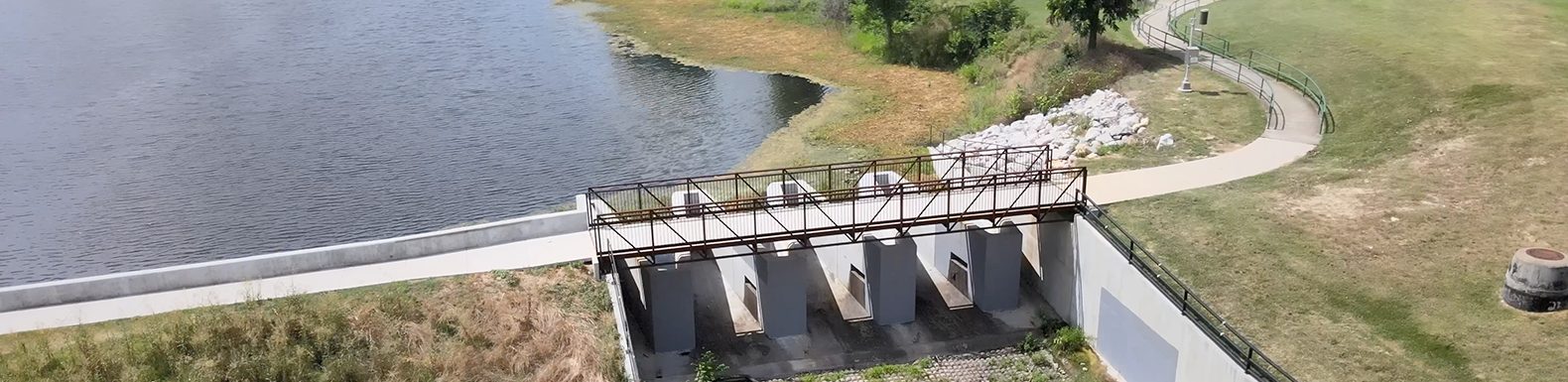
Lake Como & Oakland (Fosdick) Park Dam
Fort Worth, Texas
Expertise
- Municipal
Services
- civil engineering
- land surveying
- structural engineering
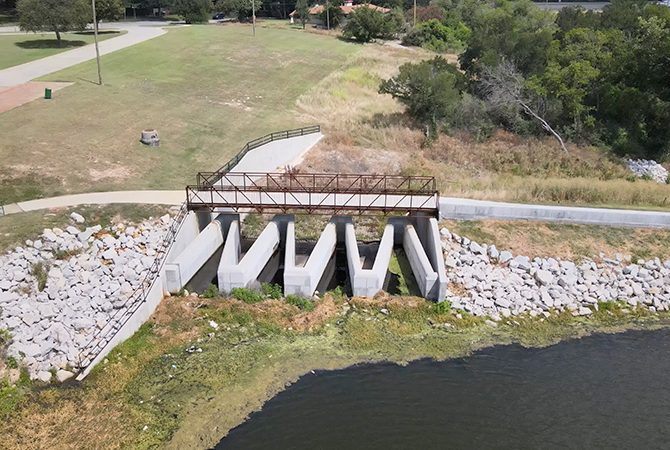
When the City of Fort Worth identified critical maintenance and safety concerns at the Oakland (Fosdick) Lake Dam and Lake Como Dam, BHB was engaged to evaluate existing conditions and develop long-term repair and improvement solutions that would bring both structures into compliance with Texas Commission of Environmental Quality (TCEQ) dam safety standards—while preserving their roles as community and park amenities.
BHB began with detailed onsite inspections to confirm deficiencies noted in routine TCEQ inspection reports, identify additional issues, and prepare inspection and recommendation reports with Engineer’s Opinions of Probable Cost (EOPCs) for multiple improvement options. These studies addressed erosion, structural deterioration, hydraulic capacity, and regulatory constraints, and ultimately led to BHB being retained for full design services for both dams.
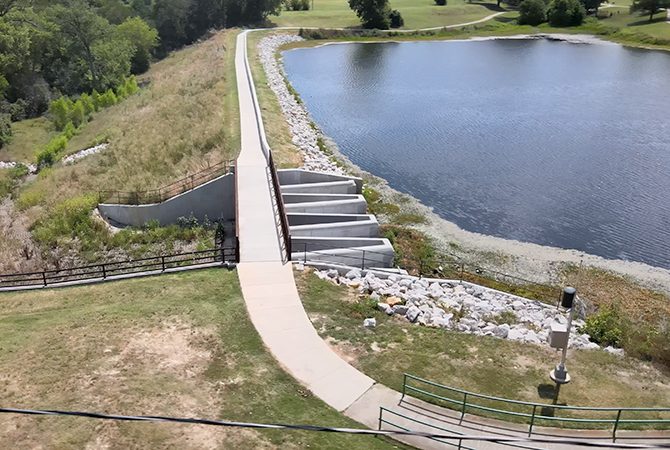
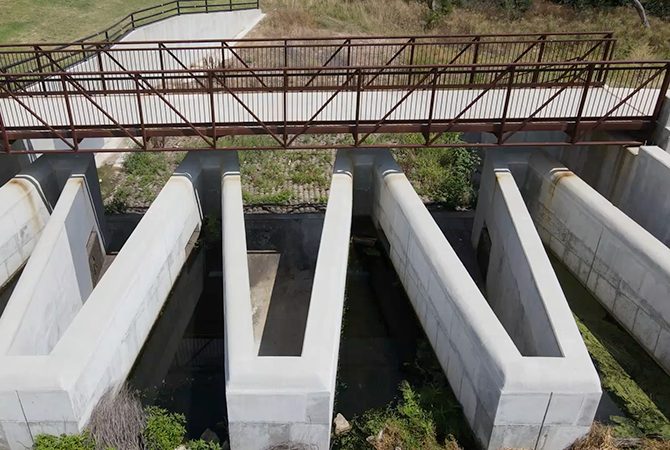
At Oakland (Fosdick) Lake, the project was driven by the failure of the original masonry and concrete culvert spillway, which had collapsed and required replacement and upsizing. The design was further complicated by the presence of Waters of the U.S. (WOUS), a significant backwater effect from Interstate 30 downstream of the dam, and the requirement that the modified dam safely pass the 75% Probable Maximum Flood (PMF)—approximately three times larger than the 100-year storm—without increasing 100-year discharge rates. To address these constraints while minimizing park impacts and controlling costs, BHB designed a labyrinth weir with openings at the normal pool elevation and a parapet wall along the dam crest. This solution safely conveyed extreme storm events, maintained pre-project 100-year discharge rates, qualified for a Nationwide Permit under Section 404 of the Clean Water Act, and allowed for the installation of a 52-foot pedestrian bridge to restore the park trail crossing.
At Lake Como, the dam and spillway are integral to Merrick Street, which connects the surrounding community and provides pedestrian access around the lake. BHB’s work focused on repairing the eroded upstream slope, addressing cracking and spalling in the spillway, stabilizing drainage channels, and integrating wave-action protection to prevent future deterioration. These repairs were coordinated with improvements to the adjacent sidewalk to enhance pedestrian safety and access, ensuring the dam continued to function as both infrastructure and a community asset.

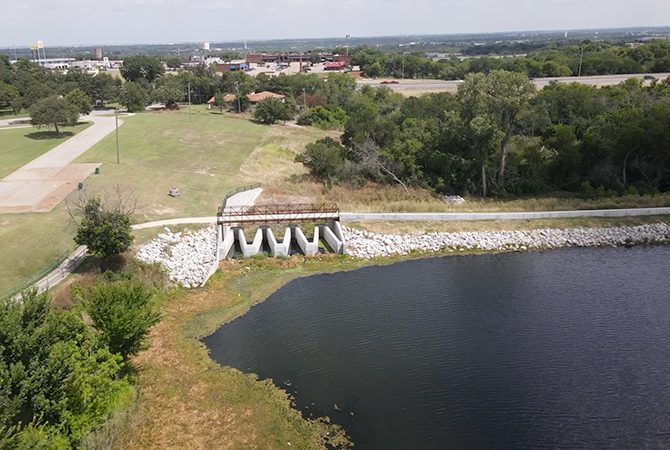
Throughout both projects, BHB worked closely with TCEQ and environmental consultants to streamline permitting, address Waters of the U.S. constraints, and keep the projects moving despite evolving regulatory and construction challenges. Advanced hydraulic and hydrologic modeling was used to account for localized inflows, backwater effects, and downstream culvert limitations—conditions that could not be fully captured using standard modeling approaches. Construction for Oakland (Fosdick) Lake is currently underway, with future phases including the preparation of Emergency Action Plans and Operation and Maintenance manuals for both dams. Together, these projects deliver resilient, regulation-compliant infrastructure solutions that protect public safety while enhancing Fort Worth’s park spaces for years to come.
Key People
-
Shannon L. Nave, PE, CFM
Shannon L. Nave, PE, CFM
Principal | Senior Civil Engineer
Shannon Nave’s desire is to use engineering to leave the world a better place than he found it and to help man live with nature and with each other. His extensive experience includes engineering design and project management for a significant variety of civil and water resource projects.
His wide-ranging experience in working for both consulting firms and as a municipal staff engineer includes flood studies, dam design and repair, expert witness testimony, and general civil projects encompassing designs for residential, commercial, educational, utility, and Capital Improvement Projects (CIP).
Shannon’s research and master’s thesis on storm water flow in streets and gutters led to UTA receiving a $450,000 grant from TxDOT to build a street section in the basement of the UTA Nedderman Hall to run full-scale tests.
Shannon lives in Parker County with his wife Anna and two sons; he enjoys cooking, reading, and working with the Cub Scouts.
Education
Tarleton State University:
Bachelor’s Degree/1996/Hydrology and Water Resources
University of Texas at Arlington:
Master’s Degree/2000/Civil Engineering: Water Resources -
John Margotta, RPLS
John Margotta, RPLS
Vice President of Land Surveying
John Margotta has been with BHB for over 20 years. Previously, John worked for a company that provided surveying services to BHB. Shortly after BHB added a surveying department, John joined the team and is now the head of the surveying department. He has provided field and office supervision on land surveying projects for public and privately funded projects, including the DFW Airport, City of Fort Worth, TXU Electric, Southwestern Bell Telephone Co., Trinity River Authority, Federal Aviation Administration, TxDOT, Dallas Area Rapid Transit, Railtran, and Fort Worth Transportation Authority.
In high school, John held the rank of Master in the Fédération Internationale des Échecs (World Chess Federation). Outside of work, John loves cooking, football and karaoke. If he wasn’t a land surveyor, John would be a chef. “Cooking is very relaxing to me and I feel like I’m creating something good out of raw ingredients that may or may not taste good by themselves.” John’s favorite place to visit is New York City because he loves the different cultures, food, and architecture it has to offer.
John is an active member of the Texas Society of Professional Surveyors and the National Society of Professional Surveyors. He also volunteers for Skills USA, teaching high school-aged kids, who compete in local, state and national competitions, about land surveying.
John has two kids, a son who who graduated from The University of North Texas with a degree in graphic design, and a daughter who works for Mothers Milk Bank of North Texas, a nonprofit that collects breastmilk from healthy, nursing mothers who have a surplus and is dispensed to premature and fragile infants without access to their mother’s own milk. He also has one granddaughter. John’s favorite quote is from Winston Churchill, “Success is not final; failure is not fatal; it is the courage to continue that counts,” because he believes that one is never finished in life and even if you fail, at least you tried.
Project Experience
Catholic Charities of Fort Worth
Fort Worth Country Day Lou and Nick Martin Campus Center
Fort Worth Country Day Sid W. Richardson Visual Arts Center
Imperial Construction Office and Shop
Early Learning Center
Meadowview Estates Channel Improvements
Monterra Medical Campus
Park Hill Surgery Center
Presbyterian Night Shelter Morris Foundation Women & Children's Center
Rogers Road Pavilion
Saint Patrick Cathedral Parish Hall
Star-Telegram Building
Tarrant County Downtown Courthouse
Texas Wesleyan University Rosedale Renaissance
Education
ITT Technical Institute