






































































On February 1, 2026, the City of Fort Worth’s updated Floodplain Provisions ordinance went into effect with citywide Valley Storage requirements. While similar Valley Storage requirements have been in place since the 1990s through the Corridor Development Certificate process as part of the Trinity River Common Vision Program, the requirements only applied to the Regulatory Zone of the Clear Fork and West Fork of the Trinity River. The updated ordinance extends the valley storage requirements to be citywide and applies to additional storm events.
For developers, property owners, and engineers, the updated ordinance may have significant implications for site grading, layout, and permitting schedules, particularly when floodplain or valley storage impacts are identified late in design. Our team has extensive experience navigating Fort Worth’s Drainage Study and Flood Study requirements, including projects requiring a Corridor Development Certificate (CDC) as part of the Trinity River Common Vision Program. Below, we will outline the updated regulations and their practical implications for your projects.
Regulatory Changes
Valley Storage refers to the natural capacity of a floodplain to temporarily store floodwaters during storm events. This storage is a critical component of flood risk management, as it slows runoff, reduces downstream flood elevations, and protects adjacent properties and infrastructure. When floodplain areas are filled without providing compensatory storage, floodwaters can move more quickly and reach higher elevations downstream, increasing the potential for flooding and erosion.
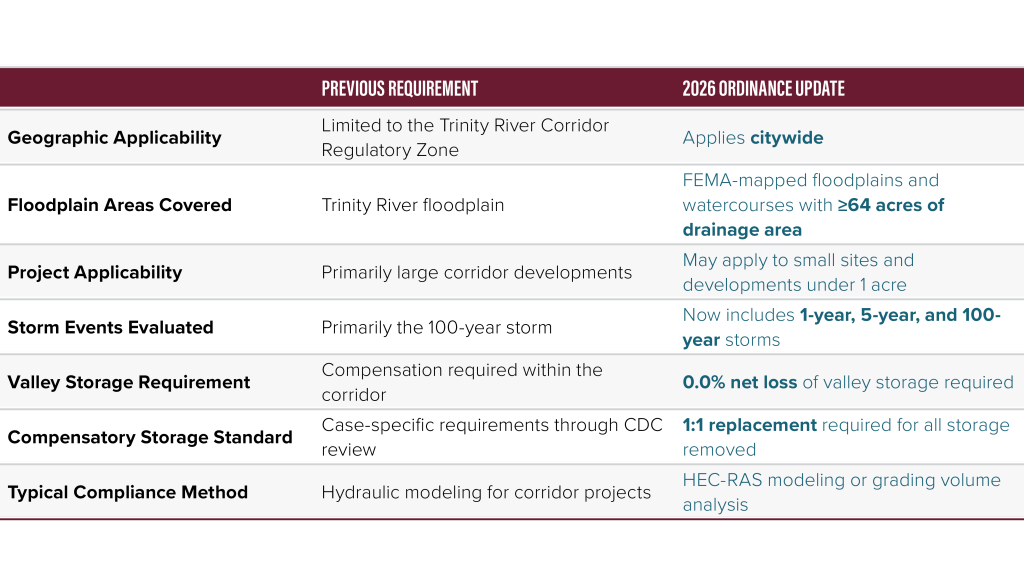
The 2026 ordinance update establishes a clear and consistent standard: no net loss of valley storage (0.0%) is permitted. Under the revised regulations, Valley Storage requirements now apply citywide, rather than being limited to the Trinity River Corridor. The standards extend to FEMA-mapped floodplains and watercourses with 64 acres or more of contributing drainage area, and they require preservation of storage not only for the 100-year storm, but also for more frequent storm events, including the 1-year and 5-year storms.
Applicability and Compliance Requirements
Projects may be subject to Valley Storage requirements if they involve grading or fill within a FEMA-designated floodplain, are located adjacent to a creek, channel, or drainageway with significant contributing drainage, or fall within a sump area behind levees. Even relatively small projects, including those under one acre, may be affected depending on the nature and extent of proposed improvements.
When fill is placed within a regulated floodplain, the ordinance requires one-to-one (1:1) compensatory storage, replacing each cubic foot of storage removed. Replacement storage must be provided at the same flood elevation and within the same watercourse reach, typically near the area of impact. Compliance is generally demonstrated through hydraulic modeling (HEC-RAS) for larger watercourse projects or grading and surface-difference analysis using CAD or GIS for smaller sites and sump areas. Projects that account for Valley Storage as a site-planning consideration early in design are typically better positioned to avoid redesign and permitting delays.
Certain activities are exempt from Valley Storage compensation requirements, including City roadway projects, utility crossings, underground storm drain pipe systems, bank stabilization efforts, and maintenance or repair of existing infrastructure. In limited circumstances where full compensation is not feasible, a variance may be requested. Variances are evaluated carefully and typically require strong technical justification and documentation of good-faith efforts to comply. Although rarely granted, the City has expressed a willingness to grant variances to the Floodplain Ordinance where full compensation for the loss of Valley Storage would have negative ecological impact or when issues of land ownership arise.
How We Support Valley Storage Compliance
Valley Storage challenges most often arise when floodplain and drainage impacts are identified late in design. Early evaluation allows compensatory storage to be integrated more efficiently into grading and site layout, often minimizing redesign, reducing earthwork, and avoiding permitting delays. Pre-submittal coordination with City staff can further clarify expectations related to reach limits, modeling approaches, and documentation requirements.
Our team routinely supports clients across Fort Worth and North Texas, from early feasibility, pre-development conferences (PDC), and through permitting and construction, by providing technical expertise and regulatory coordination related to Valley Storage compliance. Our services include early identification of Valley Storage impacts through evaluation of floodplains, drainage areas, and proposed grading; development of practical compensatory storage solutions through grading optimization and coordinated design strategies; preparation and review of required hydraulic and grading analyses; direct coordination with City reviewers during pre-submittal and permitting; and technical support for variance requests when appropriate. The result is clear expectations, reduced review cycles, and a more predictable path through permitting.
Fort Worth’s updated Valley Storage regulations reflect a broader emphasis on resilience, risk reduction, and responsible development. While these requirements may be new for some areas of the city, the underlying principles are increasingly standard throughout North Texas. With the right technical approach and early coordination, Valley Storage compliance can be integrated efficiently and effectively into project design.